Print Article
Author's Bias | Interpretation: conservative | Inclination: promise | Seminary: none
Announced in October 2025 by the Israel Antiquities Authority, a unique and first of its kind discovery of
a pottery sherd inscribed with Akkadian cuneiform was made during an archaeological excavation near the
Western Wall of the Temple Mount.
Dr. Ayala Zilberstein of the Israel Antiquities Authority, in collaboration with the City
of David Foundation, directed the excavation in Jerusalem's Davidson Archaeological Park, which is managed by
the Company for the Reconstruction and Development of the Jewish Quarter. The rare inscription was deciphered
in collaboration with Dr. Filip Vukosavović and Dr. Anat Cohen-Weinberger of the Israel Antiquities Authority,
together with Dr. Peter Zilberg of Bar-Ilan University.
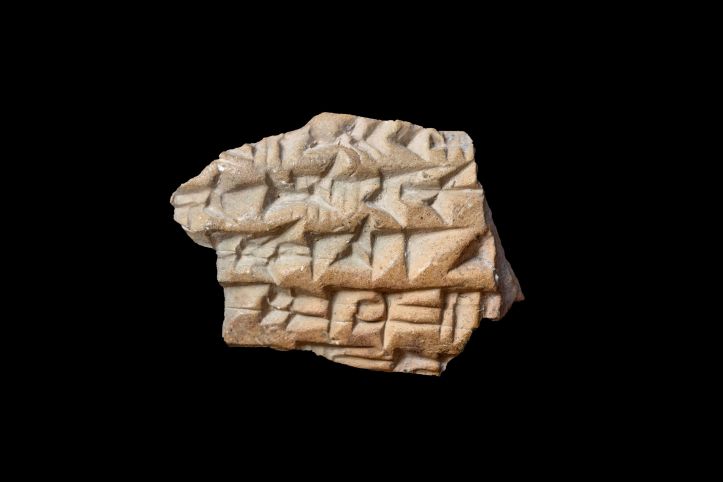
Photo credit: Eliyahu Yannai
City of David Foundation
Measuring about one inch in size, this inscribed fragment was of unique and rare historical significance.
It was the first cuneiform fragment in Assyrian dated some 2,700 years ago during the First
Temple period (8th - 7th B.C.). This places the fragment during the reign of Judean kings Hezekiah, Manasseh, or
Josiah when Judah was a vassal state of Assyria.
Petrographic analysis reveals that the sherd is composed of clay from the Tigris River basin
in Mesopotamia, rather than locally produced in Jerusalem. The fragment is likely from one of the administrative
centers of Assyria such as Nineveh, Ashur, or Nimrud / Kalḫu.
Assyriologists note that this is the very first direct evidence of official, and perhaps even
tense, communication that took place between Jerusalem and the world's most powerful superpower during this
period. This discovery provides a deeper understanding of the depth of the Assyrian presence in Jerusalem, and
the extent of its influence on and involvement in the conduct of the affairs of the Judean kingdom.
The location of the find contributes to the understanding that the slopes of the hill west of
the Temple hosted political and administrative activities of high ranking ministers and officials. Earlier
excavations by the Israel Antiquities Authority found two large administrative buildings in the Mordot Arnona
neighborhood of Jerusalem which were dated to the time of Sennacherib.
Researchers believe that the inscribed fragment is part of an Assyrian royal sealing – an official seal
accompanied by a short description of the dispatch's contents, which was likely a letter from the king of
Assyria to the king of Judah.
One expert summarized the inscription as follows: "Dear king of Judah, send the tribute
quickly by the first of Av and if not the consequences will be severe."
Analysis of the inscription fragment reinforces the hypothesis that the sealed document dealt
with a delay in the payment of a tax or another obligation. And the inscription specified a due date – the first
of the month of Av, which is consistent in a calendar shared between Mesopotamia and Judah.
Furthermore, it explicitly mentions a chariot officer, the "one who holds the reins." This
title, in Assyrian, indicates a high-ranking personality, responsible for conveying official messages on behalf
of the royal house, which is a well-known administrative process from Assyrian archives.
Although the Judean king is not named, the context and date of the fragment indicates that it might be either
King Hezekiah, Manasseh, or early in Josiah's reign, all of whom led Judah as a vassal kingdom of Assyria.
Whether from a tax revolt or technical delay in tribute, this would be the method of communication between
envoys of the Assyrian government and the rulers of Judah regarding official instructions and tribute demands.
Historically the pertinent rulers of the Neo-Assyrian empire associated with the Northern kingdom Israel and
Southern kingdom Judah were:
Shalmaneser V, also known as Ululayu (r. 727–722 B.C.), initiates and largely conquers the
Northern kingdom Israel.
Sargon II (r. 722-705 B.C.), deposing Shalmaneser V, completes the fall of the Northern
kingdom Israel (722 B.C.), and oversees the deportation and exile of its citizens.
Sennacherib, son of Sargon II (r. 705-681 B.C.), experiencing rebellions and threats to his
rule, was known for his brutal military strategies intended to instill fear in his vassal states. Despite his
invasion of Judah and siege of Jerusalem in 701 B.C., Jerusalem did not fall.
Of the Judean kings under Assyrian rule:
Hezekiah (r. 715-686 B.C.), notable for destroying the idolatrous worship of idols promoted
by his father king Ahaz, called the nation back to their covenant relationship with God and restored the Temple.
Sennacherib's military invasion of Judah is recorded in the Bible; but, with the Siloam Tunnel (also known as
Hezekiah's Tunnel which may have been constructed in part earlier),
Hezekiah succeeds in protecting the city of God, Jerusalem.
Manasseh (r. 697-642 B.C.), son of Hezekiah, is seen in Assyrian records as being a loyal
vassal to Sennacherib's son and successor Esarhaddon.
Josiah (r. 640-609 B.C.) leads the Southern kingdom Judah when the Neo-Assyrian empire was
collapsing from attacks of the Medes and Neo-Babylonians. In this vacuum, Judah had some measure of independent
rule.
Of these Judean kings, the Bible records only King Hezekiah "rebelled against the king of Assyria and did not
serve him."
7) And Yahweh was with him; wherever he went he prospered.
And he rebelled against the king of Assyria and did not serve him. 8) He struck the Philistines as far as Gaza
and its territory, from watchtower to fortified city. 9) Now in the fourth year of King Hezekiah, which was the
seventh year of Hoshea son of Elah king of Israel, Shalmaneser king of Assyria came up against Samaria and
besieged it. 10) And at the end of three years they captured it; in the sixth year of Hezekiah, which was the
ninth year of Hoshea king of Israel, Samaria was captured. 11) Then the king of Assyria took Israel away into
exile to Assyria, and put them in Halah and on the Habor, the river of Gozan, and in the cities of the Medes,
12) because they did not listen to the voice of Yahweh their God, but trespassed against His covenant, even all
that Moses the servant of Yahweh commanded; they would neither listen nor do it.
13)
Now in the fourteenth year of King Hezekiah, Sennacherib king of Assyria came up against all the fortified
cities of Judah and seized them. 14) Then Hezekiah king of Judah sent to the king of Assyria at Lachish, saying,
"I have done wrong. Turn away from me; whatever penalty you give to me I will bear." So the king of Assyria set
a penalty on Hezekiah king of Judah three hundred talents of silver and thirty talents of gold. 15) Thus
Hezekiah gave him all the silver which was found in the house of Yahweh and in the treasuries of the king's
house. (2 Ki 18:7-15)
Copyright ©
2026
Helpmewithbiblestudy.org. All rights to this material are reserved. We encourage you to print the material for personal and
non-profit use or link to this site. If you find this article to be a blessing, please share the link so that it may rise in
search engine rankings.