Print Article
Author's Bias | Interpretation: conservative | Inclination: promise | Seminary: none
When archaeological findings substantiate the historical existence of an obscure government official, what
are the implications to the historical accuracy of God's word?
In 1881, Hormuzd Rassam, an Assyrian archaeologist excavating in Borsippa, southwest of the Euphrates River,
recovered a group of ancient Persian cuneiform tablets. Because these tablets mention the name Tattannu, the
collection became known as the Tattannu Fragment Archive, and they were later determined to be administrative
records documenting transactions and governance of the Persian empire during the reign of Darius the Great
(Darius I, 521-486 B.C.).
One clay tablet, a promissory note dated to 502 B.C., listed a witness who served "Tattannu,
governor of Across the River." The significance of this recorded name would not be realized until much later
when scholars had the opportunity to closely study all of the cuneiform of the Tattannu Fragment Archive.
Additional tablet fragments containing the name Tattannu (and dated to the reign of Darius
I) were recovered during the German Oriental Society's 1905 excavations in Babylon by Robert Koldewey and were
added to the Tattannu Fragment Archive. These ancient Babylonian cuneiform inscriptions are now housed in the
research collections of Berlin's Vorderasiatisches Museum, the British Museum, the Yale Babylonian Collection,
and the Harvard Semitic Museum.
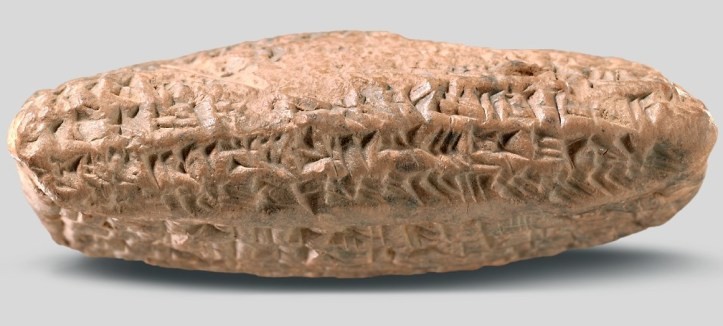
The Tattannu Fragment that lists a servant of Tattannu,
Governor Across the River as
a witness to a transaction.
Photo Credit: Olaf M. Teflmer /
BPK / Vorderasiatisches Museum, SMB
When Cyrus the Great (559-530 B.C.) conquered and established the Persian Achaemenid empire (535 B.C.), he
divided it into two areas: Babylon and Across the River.
To the Persians, Across the River or Beyond the River described the empire west of the
Euphrates. Jerusalem was considered a part of Assyria, which the Persians associated with the territory of Syria,
Phoenicia, Palestine, and Cyprus. When Darius the Great came into power (522 B.C.), he further divided the
Persian empire into 20 administrative provinces; but, the description Across the River or Beyond the River
carried over.
In seeking to understand the economic and administrative history of Babylon, subsequent studies and
reevaluation of the Tattannu Fragment Archive identified Tattannu as a high Persian official overseeing revenue
collection from leases of water access in the land "Across the River."
As Steward of the Temples, Tattannu was also in charge of ensuring that a portion of the
revenue collected would be used to maintain and restore temples. It is suspected that this was the source of
revenue to rebuild the Temple and the walls of Jerusalem.
Tattannu was a subordinate of Ushtannu and likely resided around the administrative center in
Damascus.
By 1923, Walther Schwenzner identified Tattannu as the biblical Tattenai, the governor of the
province beyond the River introduced in Ezra 5:3. This would
be subsequently confirmed and undisputed by later scholars.
At that time Tattenai, the governor of the province beyond the River, and
Shethar-bozenai and their colleagues came to them and spoke to them thus, "Who issued you a decree to rebuild
this house and to complete this structure?" (Ezra 5:3)
How does this all fit within biblical history? Cyrus the Great (559-530 B.C.) establishes the Persian
Achaemenid empire. The next leader of the Persian empire is Cambyses (530-522 B.C.) and then by Darius I (Darius
the Great, 521-486 B.C).
For violating Cyrus the Great's edict of "praying, giving thanks, and making petition and
supplication" to God (Dan 6:10-11), Daniel is cast into the
lion's den (Dan 6:12-17). But because of Daniel's faith in God
(Heb 11:32-33), his lack of injury testified to Cyrus the
Great of the reality of Daniel's God (Dan 6:23).
Cyrus the Great makes a public proclamation glorifying Daniel's God placing an emphasis on:
1) Daniel's God is alive and active in human history, 2) God's rule is eternal, and 3) God can miraculously
rescue and save His people (Dan 6:25-27). And it is worthy to
note that Daniel 6 was written in Aramaic as this message was
for the Medo – Persian Empire.
Cyrus the Great is so impressed with Daniel and his God that he frees the Jews so that they
may return to Jerusalem.
Now in the first year of Cyrus king of Persia, in order to fulfill the word of the
Lord by the mouth of Jeremiah, the Lord stirred up the spirit of Cyrus king of Persia, so that he sent a
proclamation throughout all his kingdom, and also put it in writing, saying: "Thus says Cyrus king of Persia,
'The Lord, the God of heaven, has given me all the kingdoms of the earth and He has appointed me to build Him a
house in Jerusalem, which is in Judah. Whoever there is among you of all His people, may his God be with him!
Let him go up to Jerusalem which is in Judah and rebuild the house of the Lord, the God of Israel; He is the God
who is in Jerusalem. Every survivor, at whatever place he may live, let the men of that place support him with
silver and gold, with goods and cattle, together with a freewill offering for the house of God which is in
Jerusalem.'" (Ezra 1:1-4)
Also King Cyrus brought out the articles of the house of the Lord, which Nebuchadnezzar
had carried away from Jerusalem and put in the house of his gods; and Cyrus, king of Persia, had them brought out
by the hand of Mithredath the treasurer, and he counted them out to Sheshbazzar, the prince of Judah. Now this
was their number: 30 gold dishes, 1,000 silver dishes, 29 duplicates; 30 gold bowls, 410 silver bowls of a second
kind and 1,000 other articles. All the articles of gold and silver numbered 5,400. Sheshbazzar brought them all
up with the exiles who went up from Babylon to Jerusalem. (Ezra 1:7-11)
Then they gave money to the masons and carpenters, and food, drink and oil to the
Sidonians and to the Tyrians, to bring cedar wood from Lebanon to the sea at Joppa, according to the permission
they had from Cyrus king of Persia. (Ezra 3:7)
But Zerubbabel and Jeshua and the rest of the heads of fathers' households of Israel
said to them, "You have nothing in common with us in building a house to our God; but we ourselves will together
build to the Lord God of Israel, as King Cyrus, the king of Persia has commanded us." Then the people of the
land discouraged the people of Judah, and frightened them from building, and hired counselors against them to
frustrate their counsel all the days of Cyrus king of Persia, even until the reign of Darius king of Persia.
(Ezra 4:3-5)
However, in the first year of Cyrus king of Babylon, King Cyrus issued a decree to
rebuild this house of God. Also the gold and silver utensils of the house of God which Nebuchadnezzar had taken
from the temple in Jerusalem, and brought them to the temple of Babylon, these King Cyrus took from the temple
of Babylon and they were given to one whose name was Sheshbazzar, whom he had appointed governor. He said to him,
"Take these utensils, go and deposit them in the temple in Jerusalem and let the house of God be rebuilt in its
place." Then that Sheshbazzar came and laid the foundations of the house of God in Jerusalem; and from then until
now it has been under construction and it is not yet completed.' "Now if it pleases the king, let a search be
conducted in the king's treasure house, which is there in Babylon, if it be that a decree was issued by King
Cyrus to rebuild this house of God at Jerusalem; and let the king send to us his decision concerning this matter."
(Ezra 5:13-17)
In the first year of King Cyrus, Cyrus the king issued a decree: "Concerning the house
of God at Jerusalem, let the temple, the place where sacrifices are offered, be rebuilt and let its foundations
be retained, its height being 60 cubits and its width 60 cubits; with three layers of huge stones and one layer
of timbers. And let the cost be paid from the royal treasury. Also let the gold and silver utensils of the house
of God, which Nebuchadnezzar took from the temple in Jerusalem and brought to Babylon, be returned and brought
to their places in the temple in Jerusalem; and you shall put them in the house of God."
(Ezra 6:3-5)
Now in the first year of Cyrus king of Persia—in order to fulfill the word of the Lord
by the mouth of Jeremiah—the Lord stirred up the spirit of Cyrus king of Persia, so that he sent a proclamation
throughout his kingdom, and also put it in writing, saying, "Thus says Cyrus king of Persia, 'The Lord, the God
of heaven, has given me all the kingdoms of the earth, and He has appointed me to build Him a house in Jerusalem,
which is in Judah. Whoever there is among you of all His people, may the Lord his God be with him, and let him
go up!'" (2 Chron 36:22-23)
During the reign of Darius I, Tattenai, the governor of the province beyond the River,
unaware of Cyrus the Great's edict, investigates the legitimacy of the Temple's construction and seeks
verification from Darius I (Ezra 5:6-17). Cyrus the Great's
edict is confirmed (Ezra 6:1-12), and the Second Temple is
completed around 516 B.C.
There is little doubt that the Tattannu Fragment confirms the historical existence of Tattenai, the governor
of the province beyond the River. The precise details of the archaeological record matching the chronological
setting and Tattannai's government position and authority further confirms the accuracy of the biblical record.
References:
1. Mykytiuk L, Archaeology Confirms 3 More Bible People, Biblical Archaeology Review (Washington) 43.3 (May/June 2017): 48.
2. Windle B, Three Persian Inscriptions Related to Jewish History, Bible Archaeology Report, April 2019.
3. Stolper MW, The Governor of Babylon and Across-the-River in 486 B. C., Journal of Near Eastern Studies, Vol. 48, No. 4 (Oct., 1989), pp. 283-305.
Copyright ©
2026
Helpmewithbiblestudy.org. All rights to this material are reserved. We encourage you to print the material for personal and
non-profit use or link to this site. If you find this article to be a blessing, please share the link so that it may rise in
search engine rankings.