Print Article
Author's Bias | Interpretation: conservative | Inclination: promise | Seminary: none
Archaeology provides a unique and distinctive perspective to Bible study. Bringing to life the words of
God, archaeology's scientific approach establishes anthropologically, geographically, and chronologically the
historical reality of God's word. Take for example, the biblical city Ziklag, which the Bible mentions fifteen
times and is significant for its association with David. For the past 150 years, several sites have been
proposed for Ziklag; but, the archaeology of these sites have failed to correspond to the Bible's description
of Ziklag. Take for example:
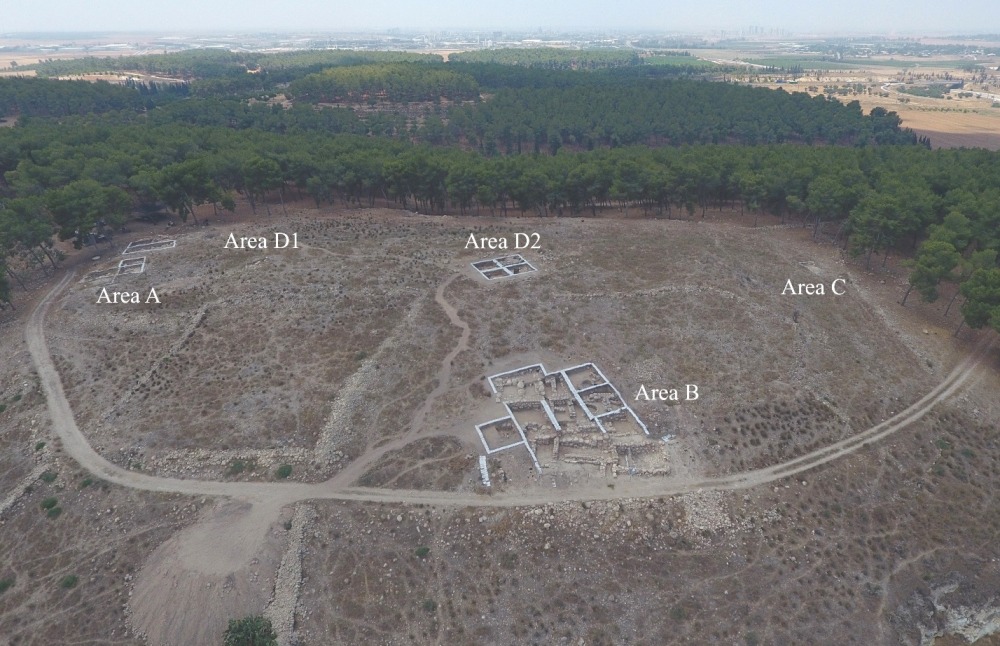
Aerial view of Khirbet al-Ra'I (1)
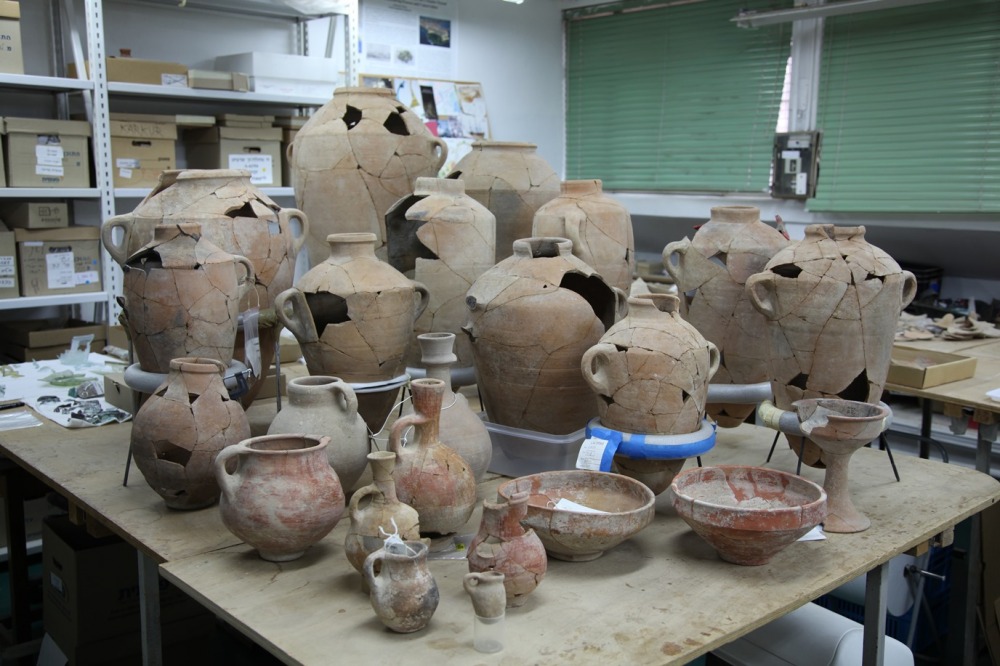
Recovered jars dated to early 10th century B.C. (2)
Assimilating with the local population over time, Philistines customarily retain the local
Semitic name of towns until their population grows and becomes significant whereupon the city takes on a
Philistine name, which is seen in Late Bronze Age cities. Retaining the Semitic name Ziklag implies that
Philistine assimilation began later until it is handed over to David.
From the account of Achish giving Ziklag to David (1 Sam 27:3-7),
Ziklag is likely within some proximity to Gath.
From spatial analysis of the Philistine settlement pattern, Philistine cities appear to be
located about half a day's walk from Gath (Garfinkel 2007) with one potential purpose to control and defend an
area. This implies that Ziklag should be at a distance of no more than 9-10 miles from Gath.
To be chronologically coincident with David, Ziklag must have evidence of Hebraic occupation
in the late 11th or early 10th century B.C. and have evidence of its destruction when the Amalekites burned it
down (1 Sam 30:1-15).
Khirbet al-Ra'i (Arabic: The Ruin of the Shepherd), a well known archaeological site, is known for its
ancient human habitation particularly Philistine around 1200-1100 B.C. Located near the water source of Nahal
Lachish, Khirbet al-Ra'i is close to the border of three geographical regions - the coastal plain, the Shephelah,
and the Negev.
Excavating the ruins of Khirbet al-Ra'i, located 2-1/2 miles west of Lachish, Yosef Garfinkel (2015-2019)
recovered archaeological evidence establishing a clear transition of cultures, from its Philistine beginnings to
a large substantial Hebraic settlement during the 10th century B.C. In consideration of all of the data,
Garfinkel and his collaborators believe that they found the biblical city Ziklag, the city that David took
refuge from Saul.
Khirbet al-Ra'i appeared to be an ideal biblical location for Ziklag. It did not have any
meaningful Late Bronze presence, and its location atop a hill was strategic and defensible. With the presence of
monumental architecture, it was likely the southern perimeter of the kingdom of Gath.
When the kingdom of Israel is established, Khirbet al-Ra'i and would sit at the border of
Israel and Philistia.
The Bible records when the Philistine king Achish gave Ziklag to David:
Then David said in his heart, "Now I will be swept away one day by the hand of Saul.
There is nothing better for me than that I should utterly escape into the land of the Philistines. Saul then
will despair of searching for me anymore in all the territory of Israel, and I will escape from his hand." So
David arose and crossed over, he and the six hundred men who were with him, to Achish the son of Maoch, king of
Gath. And David lived with Achish at Gath, he and his men, each with his household, even David with his two
wives, Ahinoam the Jezreelitess, and Abigail the Carmelitess, Nabal's wife. And it was told to Saul that David
had fled to Gath, so he no longer searched for him. Then David said to Achish, "If now I have found favor in
your sight, let them give me a place in one of the cities in the country, that I may live there; for why should
your servant live in the royal city with you?" So Achish gave him Ziklag that day; therefore Ziklag has belonged
to the kings of Judah to this day. (1 Sam 27:1-6)
A significant recovery of pottery sherds established, without a doubt, the chronological
dating of early 10th century B.C. The recovery of well preserve pottery assemblage, complete or nearly complete,
was the consequence of a sudden destruction that occurred during this period.
The Bible records when Ziklag was attacked that chronologically corresponds to the
archaeological destruction layer found by Garfinkel:
Then it happened when David and his men came to Ziklag on the third day, that the
Amalekites had made a raid on the Negev and on Ziklag and had struck Ziklag and burned it with fire; and they
took captive the women and all who were in it, both small and great—they did not put anyone to death—and carried
them off and went their way. Then David and his men came to the city, and behold, it was burned with fire, and
their wives and their sons and their daughters had been taken captive. So David and the people who were with him
lifted their voices and wept until there was no strength in them to weep. (1 Sam 30:1-4)
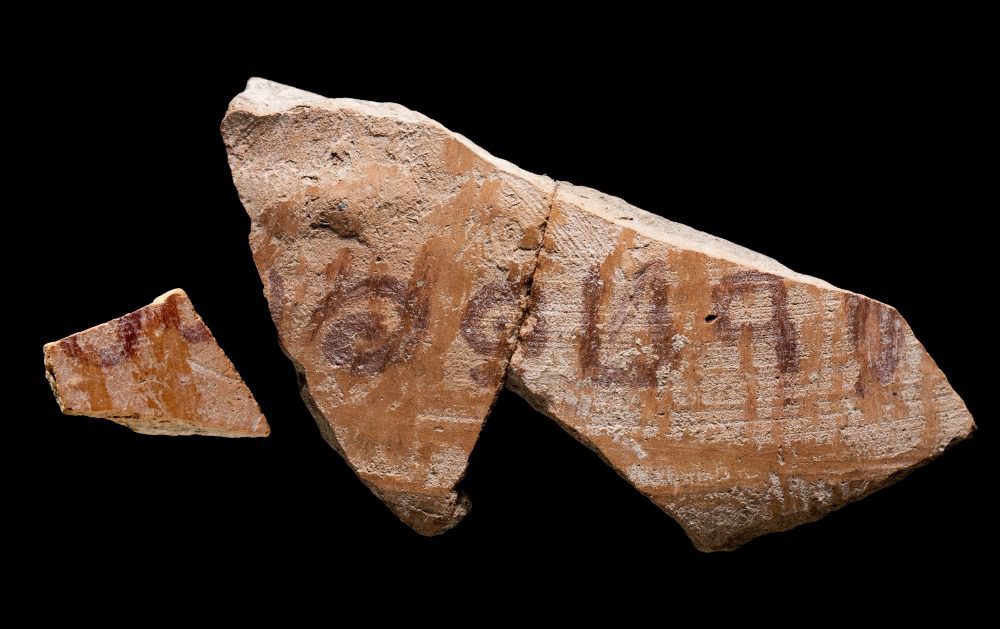
Jerubbaal Ostracon(3)
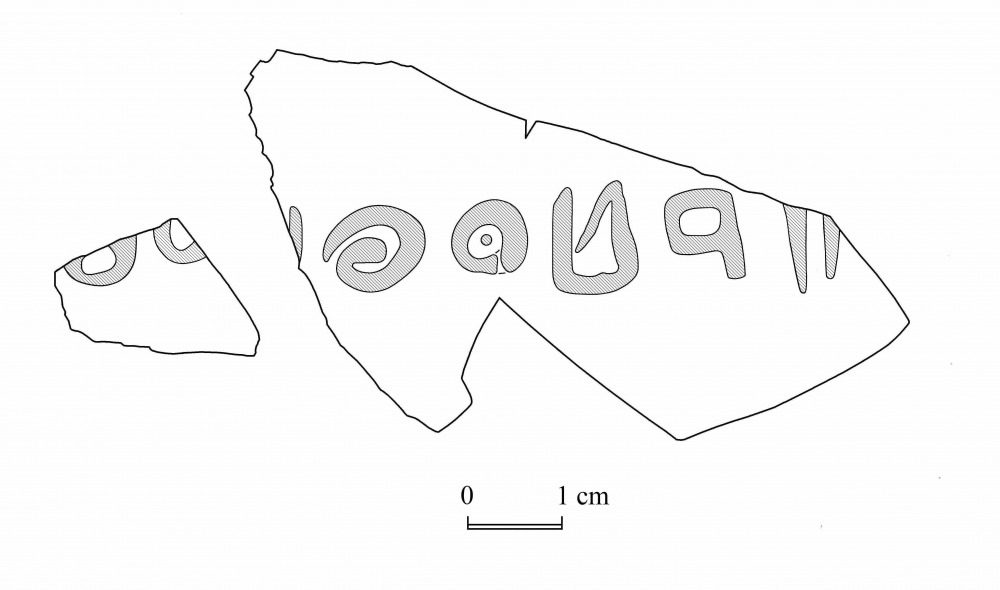
Drawing of the inscription (4)
Of particular interest was the recovery of an ostracon, a piece of pottery with an
inscription. Using pottery typology, stratigraphy, and radiocarbon dating, the ostracon was dated to around 1100
B.C., which was around the time of Judges.
In proto-Canannite script and written in ink, the ostracon bore the Canaanite name Yerubbaal
(Jerubbaal), and became known as the Jerubbaal Ostracon.
While The Bible records the Canaanite name Jerubbaal, it is associated with Gideon, a military
leader during the period of Judges. And as the Bible indicates, the Canaanite name Jerubbaal is derived from the
Hebrew root meaning "let Baal contend against him."
So Gideon took ten men of his servants and did as Yahweh
had spoken to him; and now it happened that because he was too afraid of his father's household and the men of
the city to do it by day, he did it by night.
Then the men of the city arose
early in the morning, and behold, the altar of Baal was torn down, and the Asherah which was beside it was cut
down, and the second bull was offered on the altar which had been built. And they said to one another, "Who did
this thing?" And when they searched about and inquired, they said, "Gideon the son of Joash did this thing." Then
the men of the city said to Joash, "Bring out your son, that he may die, for he has torn down the altar of Baal,
and indeed, he has cut down the Asherah which was beside it." But Joash said to all who stood against him, "Will
you contend for Baal, or will you save him? Whoever will contend for him shall be put to death by morning. If he
is a god, let him contend for himself, because someone has torn down his altar." Therefore on that day he named
him Jerubbaal, that is to say, "Let Baal contend against him," because he had torn down his altar. Now
all the Midianites and the Amalekites and the sons of the east assembled themselves; and they crossed over and
camped in the valley of Jezreel. (Judg 6:27-33)
The Bible associates Gideon with the Jezreel Valley (Judg 6:33),
some 35 miles or so from where the Jerubbaal Ostracon was found. While few would desire the name Jerubbaal, "Let
Baal contend against him," the Jerubbaal Ostracon could be, at best, circumstantial evidence of the biblical
Gideon.
Identifying Khirbet al-Ra'i as the biblical Ziklag contributes to the growing body of archaeological evidence
of a large and powerful Hebraic kingdom. Particularly significant is Khirbet al-Ra'i archaeological evidence
confirming the rise of King David as the Bible described.
References:
1. Photo credit: The Institute of Archaeology of The Hebrew University of Jerusalem.
2. Photo credit: Kyle Keimer, The Institute of Archaeology of The Hebrew University of Jerusalem.
3. Photo credit: Dafna Gazit, The Israel Antiquities Authority.
4. Illustration credit: Olga Dubovsky, The Israel Antiquities Authority.
5. Garfinkel Y, Keimer KH, Ganor S, Rollston C, and Ben-Shlomo D, Khirbet al-Ra‘i in the Judean Shephelah: The 2015–2019 Excavation Seasons in Strata: Bulletin of the Anglo-Israel Archaeological Society, vol. 37, 2019.
6. Garfinkel Y and Ganor S, Was Khirbet al-Ra‘i Ancient Ziklag? In Strata: Bulletin of the Anglo-Israel Archaeological Society, vol 37, 2019.
7. Garfinkel Y and Ganor S, Khirbet al-Raʿi near Lachish in Tell it in Gath, Studies in the History and Archaeology of Israel, eds. Shai I, Chadwick JR, Hitchcock L, Dagan A, McKinny C, and Uziel J, Zaphon, Münster, p. 943, 2018.
8. Keimer KH, Biblical Ziklag: the Case for Khirbet er-Ra‘I, Palestine Exploration Quarterly, vol. 155, no. 2: 115–134, 2023.
9. Rollston C, Garfinkel Y, Keimer KH, Davis G, and Ganor S, The Jerubba‘al Inscription from Khirbet al-Ra‘i: A Proto-Canaanite (Early Alphabetic) Inscription in Jerusalem Journal of Archaeology, vol 2: 1–15, 2021.
10. From the website of Associates for Biblical Research: Holston C, The Jerubbaal Pottery Fragment Found Near Lachish.
Copyright ©
2026
Helpmewithbiblestudy.org. All rights to this material are reserved. We encourage you to print the material for personal and
non-profit use or link to this site. If you find this article to be a blessing, please share the link so that it may rise in
search engine rankings.