While there is archaeological evidence of the historical biblical figure King David, there is little evidence
that confirms the biblical account of his son Solomon and his reign as king leading a great and powerful united
kingdom of significant regional influence.
Interpreting biblical archaeological finding is challenging as it is influenced by the
archaeologist's view of the historicity of biblical narratives and, perhaps as well, their political bias
regarding the land of modern day Israel.
This can be seen in the debate about the excavation of four sites containing large ancient
monumental gatehouses.
1902-1909
Despite excavating Tel Gezer using dubious methodology, British archaeologist Robert Macalister found
evidence of a large Canaanite city with defensive walls, towers, and gates dated to the Middle Bronze Age
(2000-1550 B.C.), which indicated that Gezer was a fortified city.
1955-1958
Israeli archaeologist Yigael Yadin excavates Tel Hazor and, besides identifying massive Canaanite structures
on the 200 acre site, discovers a six chambered city gate and casement wall. From dating of recovered pottery
sherds, Yadin believes the large unique and distinctive structures were built around the 10th century B.C.
1958
Publishing his findings in the Israel Exploration Journal, Yigael Yadin presents his theory in two articles
that the fortified gates at Hazor, Megiddo and Gezer were attributed to Solomon: "Excavations at Hazor, 1957,
Preliminary Communique" and "Solomon's City Wall and Gate at Gezer." Yadin's compelling theory was based on:
Architecture: Hazor, Megiddo, and Gezer each exhibited the same massive and fortified six
chambered gate attached to casement walls with very similar dimensions and featuring ashlar masonry often
associated with Phoenician craftsmanship.
Hazor: Yadin noted the monumental six chambered gate had a distinctive design and dated to
the 10th century B.C., which was around when the United Monarchy of the Kingdom of Israel began. Consulting the
Bible, 1 Kings 9:15 mentioned Solomon building the walls of
Jerusalem, Hazor, Megiddo, and Gezer.
Megiddo: Yadin reviewed the archaeological findings by archaeologists sponsored by the
University of Chicago in 1936-1937. Finding a similar monumental six chambered gate; but, in close proximity of
buildings with pillars and holes bored suggestive of horse stables, they believed that Megiddo was one of the
chariot cities mentioned in 1 Kings 10:26. Yadin recognized
the distinctive design of the monumental six chambered gate attributable to Solomon.
Gezer: Reviewing the work by Robert Macalister, who misidentified the half excavated six
chambered gate as a Maccabean castle (2nd century, B.C.), Yadin recognized the dimensions and ashlar
construction of the exposed half six chambered gate as attributable to Solomon.
Stratigraphy: The gates at Hazor, Megiddo, and Gezer were located at the 10th century B.C.
stratum on the basis of pottery sherds. This implied that all three gates were built during the same
chronological period using the same construction plan.
Textual: The Bible mentions the construction of the walls of all three cities, and the
evidence was supportive of an established government capable of carrying out these massive construction
projects at large cities separated by at least 90 miles.
The construction pattern Solomon used for the Temple, his own home and Jerusalem, Hazor,
Megiddo, and Gezer:
And he built the inner court with three rows of cut stone and a row of cedar beams.
(1 Ki 6:36)
So the great court all around had three rows of cut stone and a row of cedar beams
even as the inner court of the house of Yahweh, and the porch of the house. (1 Ki 7:12)
Now this is the account of the forced labor which King Solomon raised up to build the
house of Yahweh, his own house, the Millo, the wall of Jerusalem, Hazor, Megiddo, and Gezer.
(1 Ki 9:15)
King Hiram of Tyre provided the Phoenician craftsmen and materials to construct Solomon's
building projects.
1) Then Hiram king of Tyre sent his servants to Solomon,
when he heard that they had anointed him king in place of his father, for Hiram had always been one who loved
David.
2) And Solomon sent word to Hiram, saying, 3) "You know that David my
father was unable to build a house for the name of Yahweh his God because of the wars which surrounded him,
until Yahweh put them under the soles of his feet. 4) But now Yahweh my God has given me rest on every side;
there is neither adversary nor calamity. 5) So behold, I intend to build a house for the name of Yahweh my God,
as Yahweh spoke to David my father, saying, 'Your son, whom I will set on your throne in your place, he will
build the house for My name.' 6) So now, command that they cut for me cedars from Lebanon, and my servants will
be with your servants; and I will give you wages for your servants according to all that you say, for you know
that there is no one among us who knows how to cut timber like the Sidonians."
7)
Now it happened, when Hiram heard the words of Solomon, he was very glad and said, "Blessed be Yahweh today, who
has given to David a wise son over this great people." 8) So Hiram sent word to Solomon, saying, "I have heard
the message which you have sent me; I will do what you desire concerning the cedar and cypress timber. 9) My
servants will bring them down from Lebanon to the sea; and I will make them into rafts to go by sea to the place
where you direct me, and I will have them broken up there, and you shall carry them away. Then you shall
accomplish my desire by giving food to my household." 10) So Hiram gave Solomon as much as he desired of the
cedar and cypress timber. (1 Ki 5:1-10)
1964-1974
American archaeologist William Dever excavated Tel Gezer with a focus on its stratigraphy and chronology to
understand its layers of different settlement and destruction. Among his discoveries, Dever found evidence that
established that Gezer's six chambered gate was of the 10th century B.C. confirming Yadin's proposal that it was
Solomonic.
1992-2012
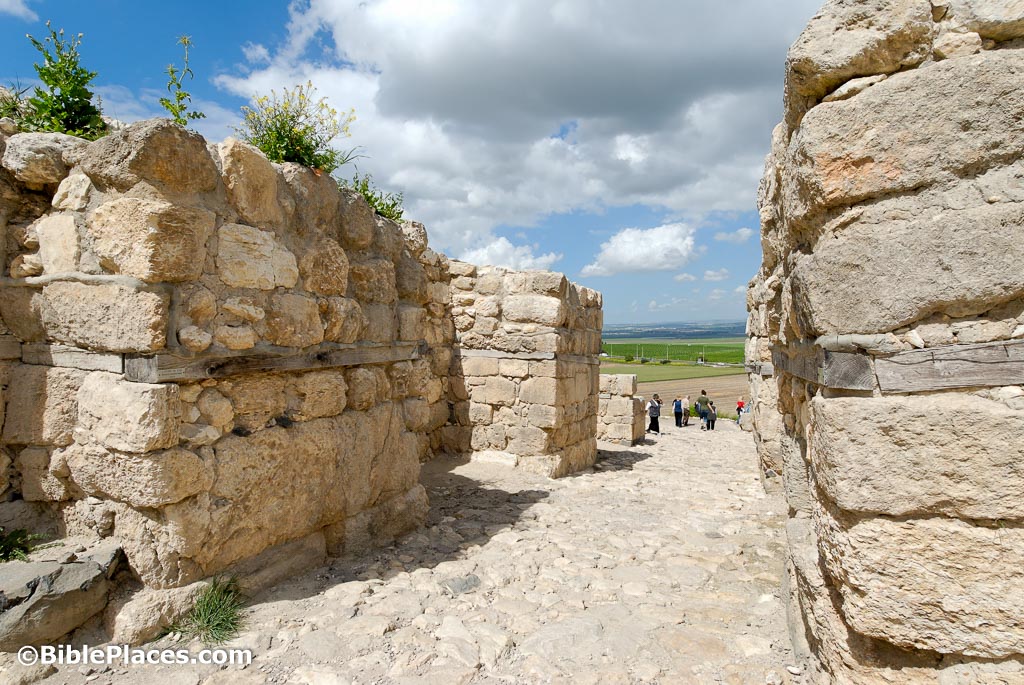
Tel Megiddo (3)
Israeli archaeologists Israel Finkelstein and David Ussishkin conduct further excavation of Megiddo and made
several significant discoveries. Pertinent to the dating of Megiddo's ashlar gate:
2000: Edited by Finkelstein, I., Ussishkin, D. and Halpern, B., Megiddo III: The 1992-1996
Seasons was published. In a chapter titled, The Iron Age Pottery Assemblages from Areas F, K and H and Their
Stratigraphic and Chronological Implications, Finkelstein and colleagues observed that the ceramic typology of
assembled pottery sherds of Megiddo were characteristic and more consistent to a date of 900-850 B.C.
2014: Published in the journal Radiocarbon, "Absolute Chronology of Megiddo, Israel,
in the Late Bronze and Iron Ages: High Resolution Radiocarbon Dating," Toffolo, Arie, Martin, Boaretto &
Finkelstein show that radiocarbon dating of Megiddo's monumental structures (i.e. gate and stables) date to
900-850 B.C. not a century earlier.
The current findings of Megiddo, based on stratigraphy, ceramic typology, and high resolution
radiocarbon dating, indicate that Megiddo's gate is firmly dated around 900 B.C. Finkelstein and other
archaeologists propose that the gates found in Hazor and Gezer are likely of the same later period of
construction.
Challenging biblical archaeology by denying the gates as Solomonic, and attributing their
construction to the period of the Divided Monarchy and Northern Kingdom Israel King Omri, who reign somewhere
around 880-875 B.C., this work produced vigorous and sharp academic debate. This meant that David and Solomon
did not reign as a powerful kings over a united kingdom of regional power and influence, and were instead tribal
chieftains leading small poor villages. Implied was that the Bible was of later composition and written to shape
and influence how Israel saw itself.
Defense of Hazor's gate as attributable to Solomon
Prominent archaeologist of Hazor, as Area Supervisor under Yigael Yadin (1955-1958, 1968) and Excavation
Director (1990-2023), Amnon Ben-Tor defended the 10th century B.C. dating of the monumental six chambered ashlar
gate based on:
Pottery sherds and assemblages at the layer of the gate's construction were typical for the
10th century B.C.
Architectural dimensions of Hazor's gate to the monumental six chambered ashlar gates of
Megiddo and Gezer were almost identical, which implied the existence of a powerful centralized government.
More recent excavations focused on the stratigraphy of Hazor confirmed Yadin's dating of the
gate's construction to the 10th century B.C. In addition, radiocarbon dating of charred olive pits at this layer
resulted in dates around 11-10 century B.C.
Defense of Gezer's gate as attributable to Solomon
2023: Published in a peer reviewed open access journal offered by the Public Library of Science (PLOS),
Austrian archaeologist Lyndelle Webster and colleagues shared their findings in "The Chronology of Gezer from
the End of the Late Bronze Age to Iron Age II: A Meeting Point for Radiocarbon, Archaeology, Egyptology and the
Bible."
The study took charred seeds from several layers of settlement and destruction from the late
13th to 9th century B.C. to determine the history of Gezer on a fixed timeline.
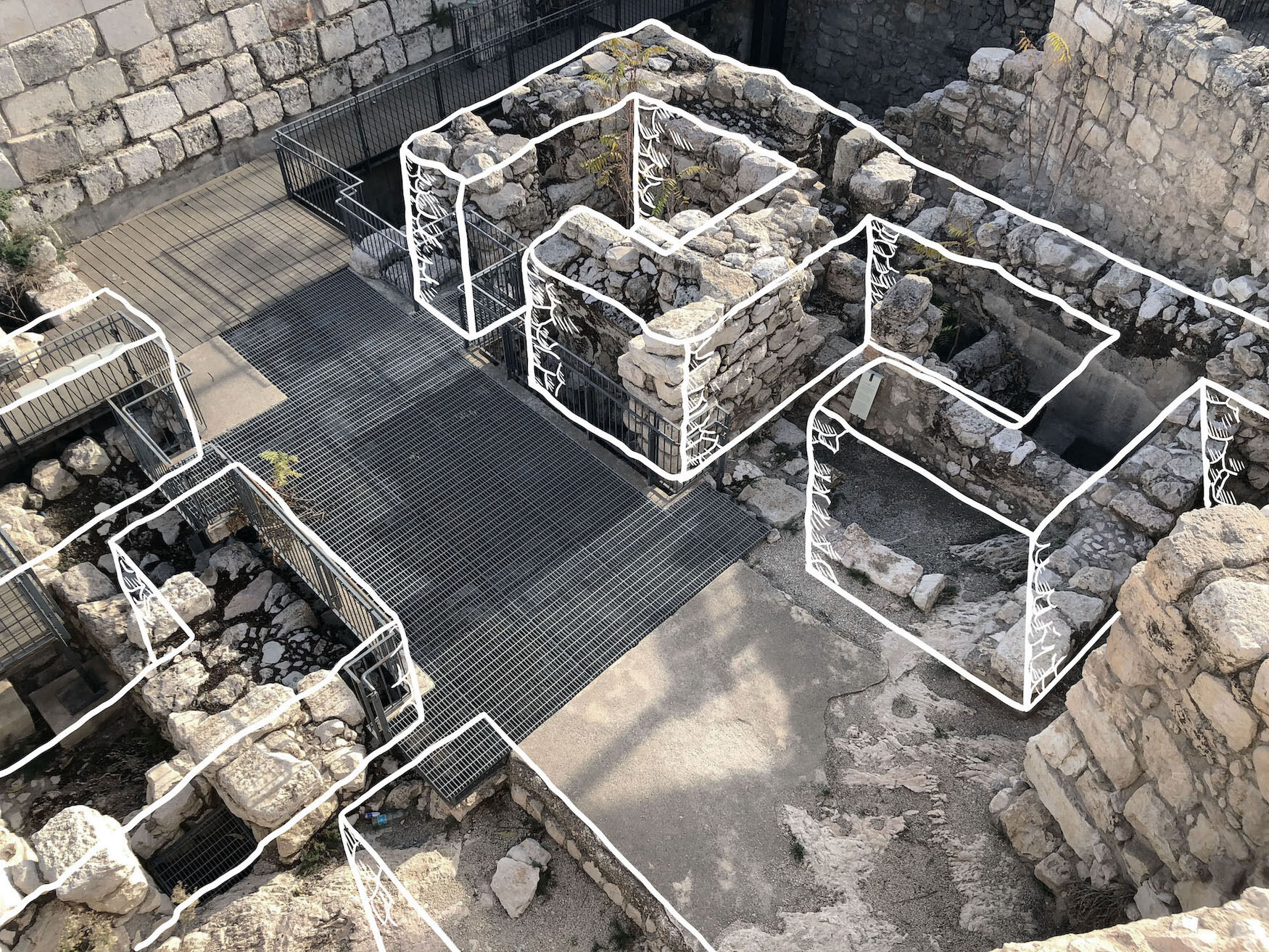
Jerusalem Ophel's Gatehouse
drawn in overlay (4)
Pertinent to Gezer's monumental six chambered ashlar gates, the team dated its construction
to the first half of 10th century B.C. and "not the 9th century B.C. as previously thought."
The large gatehouse in the Ophel of Jerusalem
As the result of excavations of the Ophel (1986-1987), Eliat Mazar and her grandfather Benjamin Mazar
reported in 1989 the unearthing of a monumental structure they initially identified as a "Royal Gateway," which
they dated roughly to late 9th – early 8th century B.C. While the monumental structure was fragmented from
destruction and not fully excavated, the remaining 4 chambered ashlar gate was clearly visible.
2006: When excavating the Eastern Hill (2005-2008), Eliat Mazar discovers the Large Stone
Structure which she associated with the Palace of King David, and the site becomes known as the City of David.
Within the context of these findings and the biblical data, Mazar redated the "Royal Gateway" to the 10th
century B.C.
2010: As director of the Ophel excavations (2009-2021), Mazar presented data confirming the
dating of Ophel's massive ashlar gates to the 10th century B.C. of King Solomon.
Pottery sherds and assemblages were very similar to pottery assemblages of other excavations
like Khirbet Qeiyafa and
Khirbet al-Ra'i that firmly date to the 10th century B.C.
Architecture design and measurements (i.e. length, thickness, chamber size, casement wall,
etc.) were almost identical to the monumental ashlar gates of Hazor, Megiddo, and Gezer. The implied a powerful
centralized government used the same engineering and construction blueprint to fortify the kingdom's cities.
|
Jerusalem |
Megiddo |
| Gate Length |
10.4 m long x 14.8 m wide |
10.2 m long x 14.6 m wide |
| Passageway Width |
4 m |
4.2 m |
| Wall Thickness |
1.5 m |
1.6 m |
| Chamber Size |
2.8 m long x 2.4 m wide |
2.8 m long x 2.2 m wide |
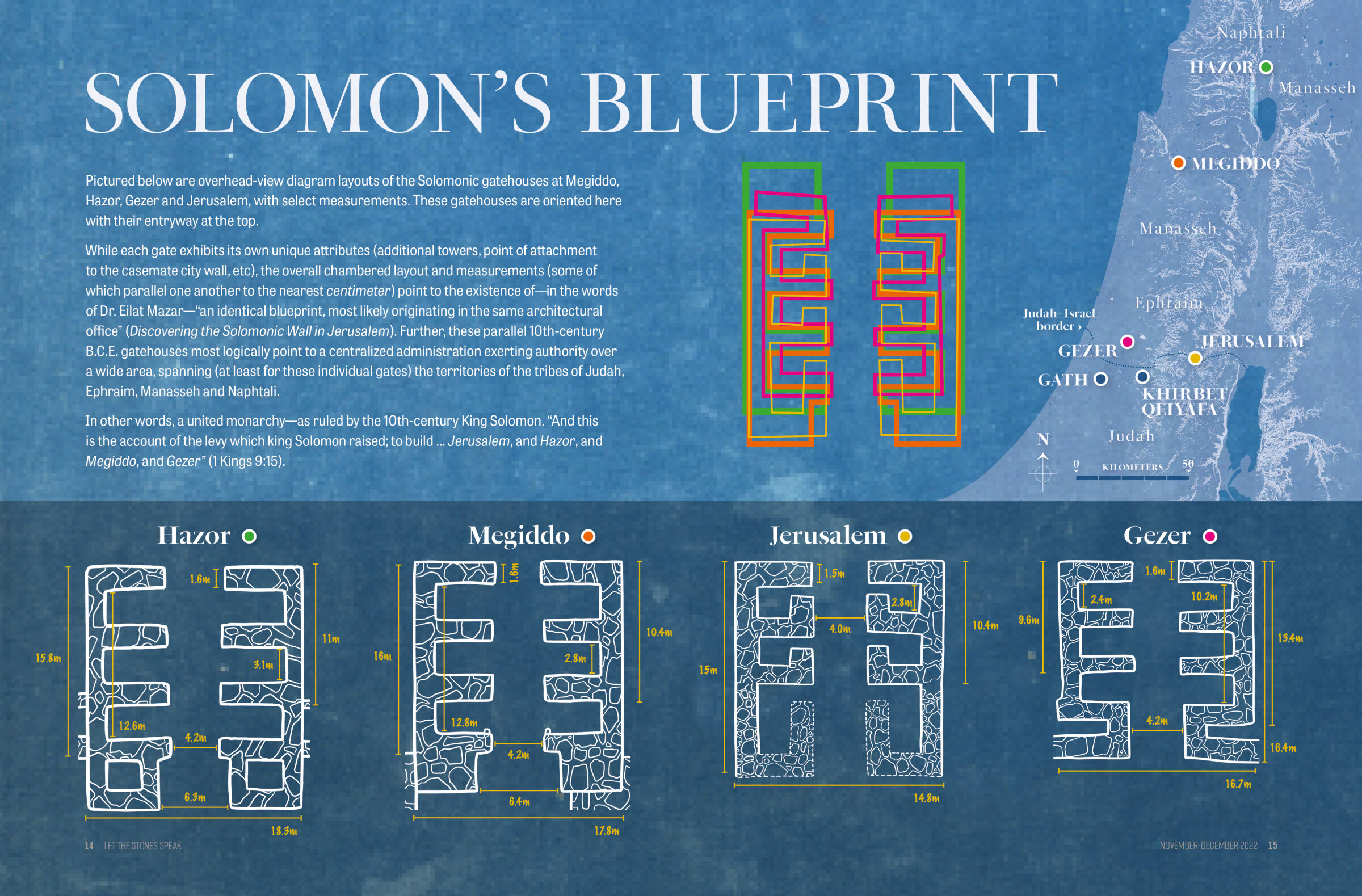
Solomon's Gatehouse Blueprint (5)
Textual evidence from 1 Kings 9:15 speaks of
the walls "of Jerusalem, Hazor, Megiddo, and Gezer." All four gates feature the same method of construction
involving rows of hewn ashlar stones, topped by a horizontal row of cedar beams, and likely topped by another
series of ashlar stones (1 Ki 6:36;
7:12).
The identification of Jerusalem's gate as Solomonic has been debated for a variety of reasons.
One issue with Jerusalem's gate was that its chambers were uniquely "closed;" instead of a three sided chamber,
each chamber had four walls with a narrow opening. However, countering this objection were archaeological
findings in Jordan at the large copper production site of Khirbet-en-Nahas.
Systematically excavating Khirbet-en-Nahas (2002-2009), Thomas Levy and Mohammad Najjar found
evidence of a large fortress settlement with a four chambered gatehouse with "closed" chambers. Architecturally,
its monumental four chambered gate was considered as one normally found at the entrance to a border fortresses
– in this case an industrial copper production complex.
Jerusalem's massive four chambered gatehouse is considered an inner gatehouse within a larger
royal complex.
From careful high precision radiocarbon dating, the fortress was constructed and copper
smelting was most active during the span of 10th to 9th century B.C. From this data, Levy and Najjar wonder if
this Edomite mine was controlled by David and Solomon as the Bible indicates:
King David also set these apart as holy to Yahweh with the silver and the gold which
he had carried away from all the nations: from Edom, Moab, the sons of Ammon, the Philistines, and from Amalek.
Moreover, Abishai the son of Zeruiah smote 18,000 of Edom in the Valley of Salt. Then he placed garrisons in
Edom, and all the Edomites became servants to David. And Yahweh granted salvation to David wherever he went.
(1 Chron 18:11-13)
Khirbet-en-Nahas' closed four chambered gate, dating, and textual evidence provided an
architectural parallel that supported Eliat Mazar's view of Jerusalem's gate as Solomonic.
Unless further excavations take place, there may not be a unanimous conclusion about Solomon's gates; however,
the evidence is very compelling. Given that Hazor, Megiddo, and Gezer were cities of the divided monarchy of the
Northern Kingdom of Israel, and Jerusalem was of the Southern Kingdom of Judah, the inclusion of Jerusalem's
gate as Solomonic is significant. Eliat Mazar's excavation of the Ophel, recovering King Hezekiah's clay bulla
(who reigned during the late 8th century) and other significant biblical figures, established that Jerusalem was
the center of government administration. And the only time that construction of identical and massive
fortifications of Jerusalem, Hazor, Megiddo, and Gezer could occur is when the kingdom was united under Solomon
who governed from Jerusalem.
References:
1. Tel Hazor photo credit: Madainproject.com.
2. Tel Gezer photo credit: Biblical Archaeology.org.
3. Tel Megiddo photo credit: Bibleplaces.com.
4. Jerusalem Ophel's Gatehouse drawn in overlay photo credit: Armstronginstitute.org.
5. Solomon's Gatehouse Blueprint photo credit: Armstronginstitute.org.
6. Stern E. "Hazor, Dor and Megiddo in the Time of Ahab and under Assyrian Rule." Israel Exploration Journal, vol. 40, no. 1, 1990, pp. 12–30. JSTOR.
7. From the Armstrong Institute of Biblical Archaeology's website: Eames C, A Study Into King Solomon's Three Four Monumental Gates, Nov-Dec 2022.
8. Mazar E, Discovering the Solomonic Wall in Jerusalem; A Remarkable Archaeological Adventure, Shoham Academic Research and Publication, 2011.
9. Mazar E, Royal Gateway to Ancient Jerusalem Uncovered, Biblical Archaeological Review, 15:03, May-Jun 1989.